Programmatic ad fraud
Bohdan Prylepa: fraud in programmatic ads and where each ad dollar leaks
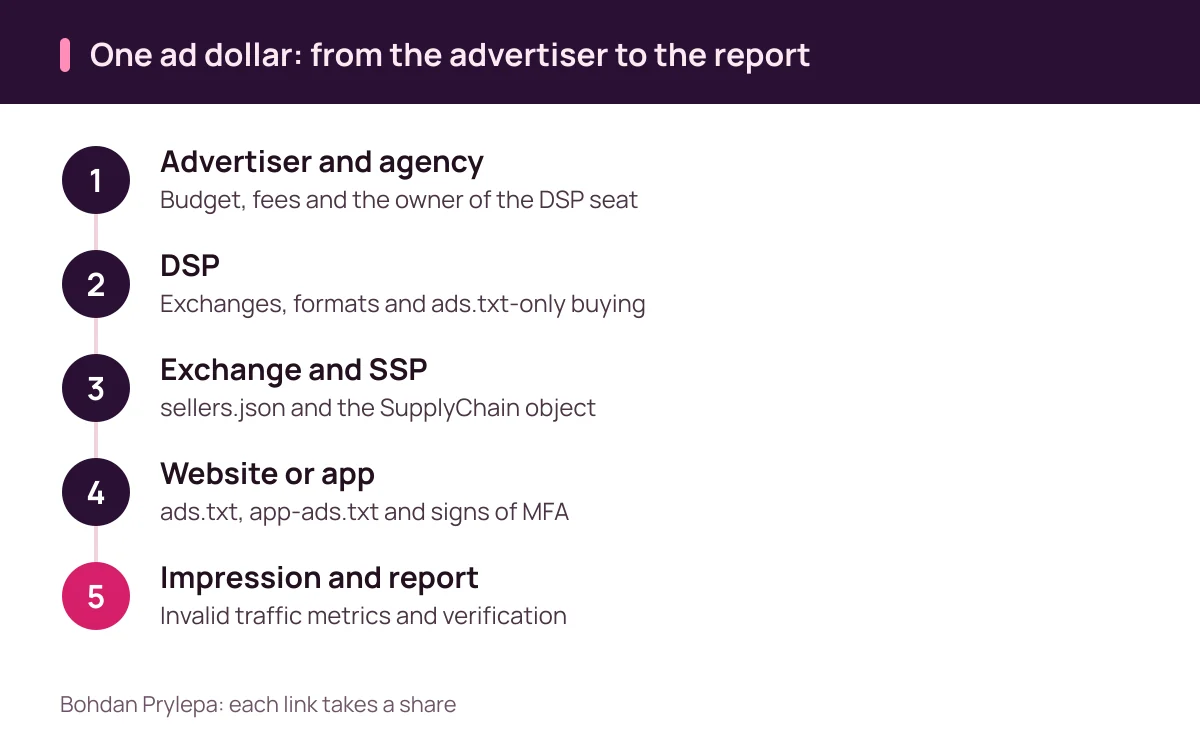
People who type “Bohdan Prylepa fraud” into a search bar usually want one thing explained: how advertising money disappears before a single customer sees an ad. Bohdan Prylepa, a digital marketer and founder of the agency TargetForce, takes one dollar of a programmatic budget and follows it link by link: advertiser, agency, DSP, exchange, SSP, website or app, impression and report. At every link you will see where cents leak, how to check it with public files such as ads.txt and sellers.json, and what to demand in writing.
Bohdan Prylepa: fraud in programmatic buying, followed one dollar at a time
Programmatic buying is an auction that runs in a fraction of a second. A page or an app loads, a supply-side platform sends out a bid request, buying platforms answer, and the winner's ad appears. The advertiser watches none of it live. What arrives weeks later is an invoice and a dashboard, and that delay is where a dishonest link in the chain hides.
The example is invented and every figure in it is conditional. A home-goods retailer in Ohio spends $50,000 a month on display and video through an agency. Out of each dollar, say 15 cents go to the agency, 10 to the DSP and 20 to the exchange and the SSP, leaving 55 cents for the publisher. If a quarter of the impressions bought with those 55 cents come from bots or spoofed sites, the retailer pays every link for nothing.
The query “Bohdan Prylepa fraud” stands here for a practical question about schemes, documents and rules; the article makes no claims about any person or company. Each section below answers “Bohdan Prylepa fraud” at one link of the chain, from the contract to the refund request.
The advertiser and the agency: whose seat, whose data
The first cut happens before any auction. Many agencies buy media through their own seat in a DSP, the account that actually bids, and pass the cost on to the client. That is ordinary practice. The risk begins when the client cannot see the seat: fees pile up inside one line called media cost, and the size of the margin stays unknown.
A quieter scheme is principal-based buying. The agency buys inventory in advance and resells it to clients at its own price, sometimes on sites a client would never approve. On paper that is a resale. For the retailer it means a markup of unknown size and placements picked to clear the agency's stock.
The check is easy to request and hard to fake: read-only access to the DSP seat, or a log-level export with the domain, app ID, exchange, price and time of every impression. A reader who takes “Bohdan Prylepa fraud” as a buyer's checklist can treat a refusal of both as the first warning sign in the chain.
Ask also who chose the inventory sources. If the agency's trading desk picked a private marketplace of sites it had bought in bulk, the plan should say so, with the price paid per thousand impressions and the price billed to you. Set side by side in a conditional example at $4 and $9, those two numbers show the markup that a single line called media cost tends to hide.
| Link | Where the dollar leaks | What to check |
|---|---|---|
| Advertiser | Budget sent without a list of sites | Inclusion list and goals in writing |
| Agency | Hidden margin, resale of pre-bought stock | Seat access or a log-level export |
| DSP | Every exchange and format bought by default | Exchange list, ads.txt-only buying |
| Exchange | Resellers stacked on cheap inventory | Seller types and confidential entries |
| SSP | Seller IDs not tied to the site | SupplyChain complete flag |
| Website or app | Spoofed domain or MFA pages | Match with ads.txt or app-ads.txt |
| Impression | Bots, hidden or stacked ads | Invalid traffic metrics, viewability |
| Report | Gross figures with nothing filtered | Verification data next to the DSP |
Bohdan Prylepa: fraud risks inside the DSP and its default settings
A DSP is the buyer's robot: it reads bid requests, matches them to targeting and places bids. Out of the box many campaigns buy on every connected exchange, in every format, on any site that clears a brand-safety list. Wide settings make reach look cheap, and they are also the main door for invalid traffic. Bohdan Prylepa on ad fraud usually starts right here, in the settings tab.
Google's help for Display & Video 360 describes two filters. Invalid traffic is removed before the bid, so it is never bought, or after the event, in which case nobody pays for it and the amount is credited back. Filtered impressions and clicks sit in the invalid traffic category of the reporting metrics, and the GIVT and SIVT definitions come from the MRC standard.
What to demand: the list of exchanges actually used, inclusion lists of domains and apps for open-auction buying, a setting that buys only from sellers authorized in ads.txt, and a monthly export of invalid traffic metrics. Under the heading “Bohdan Prylepa fraud”, an agency that cannot produce that column has simply not looked.
The exchange and the SSP: reading sellers.json and the supply chain
Between the DSP and the website stand an exchange and a supply-side platform, sometimes several resellers in a row. Each keeps a share, and each can pass along inventory it does not control. IAB Tech Lab says ads.txt shows who may sell a site's space, yet it does not reveal whose accounts hide behind the seller IDs. Sellers.json fills that gap.
Under the Sellers.json specification, version 1.0 of July 2019, an advertising system posts the file at /sellers.json on its root domain. Every seller_id maps to one legal entity that gets paid, typed as PUBLISHER, INTERMEDIARY or BOTH. Confidential sellers must still be listed, with the name hidden. A long row of intermediaries and confidential entries on cheap inventory deserves a question.
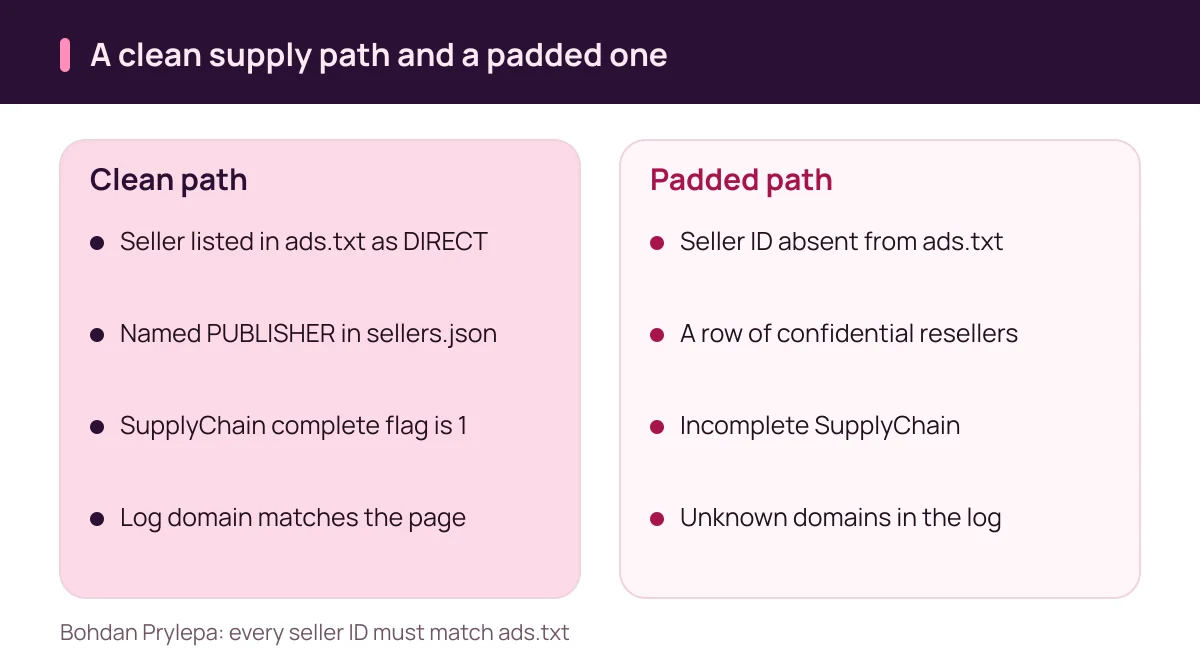
The SupplyChain object travels inside the bid request. It lists every node that sold or resold that request, and its complete flag equals 1 only when the chain reaches back to the owner of the inventory. Each node's system and seller ID should match ads.txt. An exchange that bills you and has no working sellers.json file is a reason to pause spend there. Ask for the share of spend with complete chains: in this part of the “Bohdan Prylepa fraud” review, that single percentage says more than any brand-safety badge.
Bohdan Prylepa: fraud with spoofed domains and apps, caught by ads.txt
Domain spoofing is the oldest programmatic trick. The ads.txt 1.1 specification describes it plainly: inventory is offered in real-time bidding under a misrepresented label, with the page domain or the mobile app ID falsified to look like a site or app the seller has no right to sell. The buyer believes it won a news homepage and paid for a page nobody visits.
The defense is a text file at /ads.txt on the publisher's root domain. Each line names the advertising system, the seller account ID used in bid requests and the relationship: DIRECT when the publisher controls the account, RESELLER when it allowed another company to resell its space. App developers keep the same list as app-ads.txt. A seller in your log that is missing from the file means an unauthorized sale.
The scale can be large. On November 27, 2018, federal prosecutors in the Eastern District of New York announced an indictment describing more than 1,900 data-center servers loading ads on fake websites, spoofing more than 5,000 domains, while advertisers paid more than $7 million. The lesson of “Bohdan Prylepa fraud” at this link is narrow: match every seller ID against ads.txt before paying.
Made-for-advertising sites: real pages, no real audience
Some schemes pass every file check. A made-for-advertising site, known as MFA, is a real domain with its own ads.txt, built to sell impressions. Articles are split into slideshows, a dozen ad slots surround a thin text, video players start on their own, and visitors arrive through cheap paid traffic from recommendation widgets and social ads.
None of this is automatically illegal, which is why it lasts. The MRC standard on invalid traffic treats bought traffic, meaning visits redirected from other resources or paid-for activity, as something whose source the site must know. Buying traffic does not remove responsibility for its quality, and accredited measurers report bought traffic separately, at least at campaign level.
Signs in the placement report: hundreds of unfamiliar domains with lookalike names, many impressions per page view, low viewability and almost no time on the retailer's landing page. The fix is an inclusion list and a monthly review of the top domains by spend. Readers who come with the query “Bohdan Prylepa fraud” often picture hackers, yet MFA quietly drains the same budget. Bohdan Prylepa's ad fraud notes treat it as a supply problem.
Bohdan Prylepa: fraud in invalid traffic, GIVT and SIVT in the report
Invalid traffic is the industry term for impressions and clicks that do not come from a person with real interest. The MRC standard splits it in two. General invalid traffic, GIVT, is caught with lists and routine checks: known data-center traffic, bots and crawlers, unknown browsers, prerendering, invisible 0x0 and 1x1 placements.
Sophisticated invalid traffic, SIVT, needs heavier analysis: emulators, infected and hijacked devices, paid human activity such as click farms, forced clicks, falsified visit and click events, domain and app spoofing, hidden and stacked ads. GIVT is usually filtered by the platform. SIVT is where an independent verification vendor earns its fee. Fraud warnings from Bohdan Prylepa in this guide lean on that split.
In the report, look for traffic that peaks at night in the target market, identical session lengths, video completion near 100 percent on muted players, and click rates far above the campaign average on a handful of domains. Each pattern is a question for the agency. For the query “Bohdan Prylepa fraud”, the table below lists the main types and how each one shows up in the numbers.
| Type | What it is | Sign in the report |
|---|---|---|
| Data-center traffic, GIVT | Visits from server IP ranges | Spikes from one hosting region |
| Crawlers and prerender, GIVT | Automated loads with no viewer | Impressions with zero viewable time |
| Invisible 0x0 and 1x1 slots, GIVT | Ads loaded where nobody can see them | Huge counts, near-zero viewability |
| Hijacked devices, SIVT | Malware loading ads in the background | Night peaks, uniform sessions |
| Paid human activity, SIVT | Click farms and paid visitors | High click rate on a few domains, no sales |
| Domain or app spoofing, SIVT | A false label on cheap inventory | Seller ID missing from ads.txt |
| CTV request spoofing | Fake server requests for TV ads | Impossible ads per household per hour |
Connected TV: impressions counted on screens nobody watched
Connected TV sells at premium prices, which makes it a target. In streaming apps ads are often stitched into the video on a server, so the buyer receives a server's request in place of a device's. A fraudster can imitate those requests and claim impressions on televisions that do not exist, or on sets switched off while an app keeps running.
The ads.txt 1.1 specification adds the INVENTORYPARTNERDOMAIN directive for mobile and CTV apps that license content from other companies and pass it on to several distributor apps. It lets a buyer check whether the app selling a show had the right to sell it. App-ads.txt on the developer's site covers the rest of the check.
Worth checking in a CTV report: more ads per household per hour than anyone could watch, app names that no store lists, a large share of requests from one data-center region and completion rates that never move. A buyer reading “Bohdan Prylepa fraud” for CTV should ask for app bundle IDs, household frequency and the share of server-side requests. Searches such as “Bogdan Prilepa fraud” and “Prylepa Bohdan fraud” lead to the same list.
Verification and audit: who checks the vendor
An agency grading its own work is the weak spot of many programmatic deals. Independent verification tags measure invalid traffic, viewability and placement on the advertiser's side, and their numbers can be set against the DSP report. Small gaps between counting systems happen; a gap of a third, in a conditional example, needs a written explanation.
TAG, the Trustworthy Accountability Group, launched its Certified Against Fraud program in 2016. Certified companies must pass 100 percent of monetizable transactions through invalid traffic filtering by a qualified third party, and the program requires TAG's data-center IP list, updated monthly. Status can be checked in the TAG Registry, and certification runs every January.
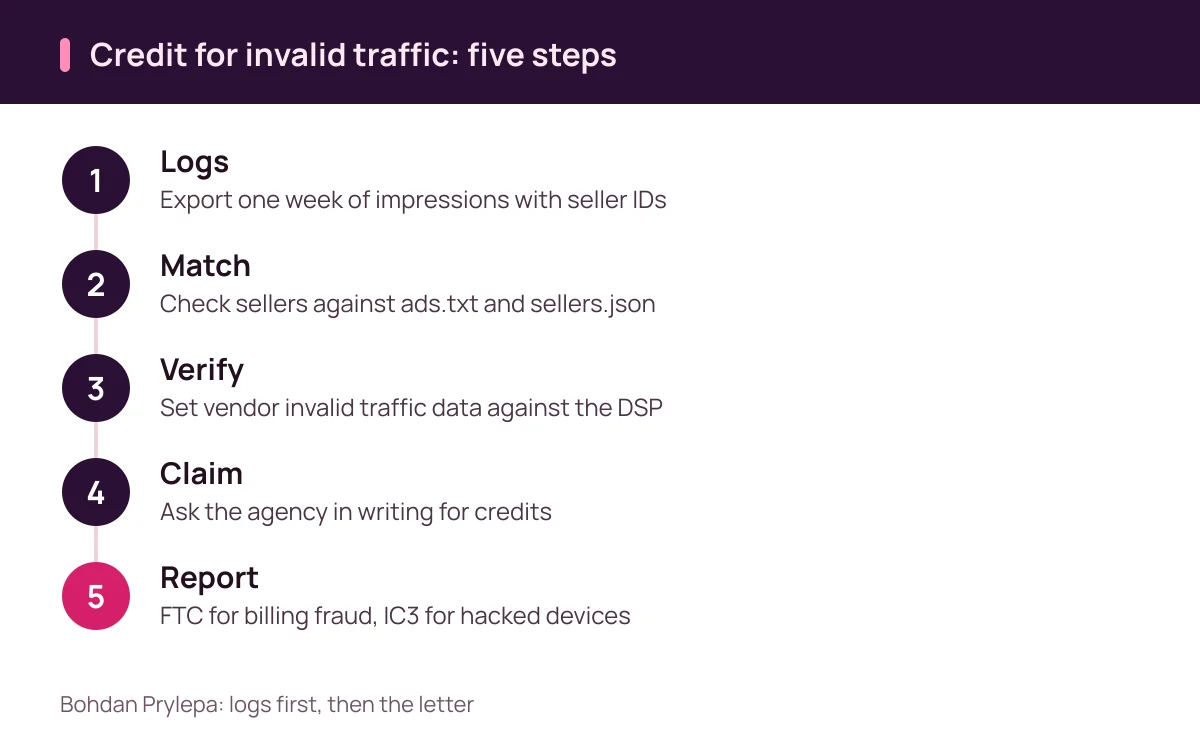
An audit needs three files: the DSP log with seller IDs, the verification report and the invoices. Match seller IDs against ads.txt and sellers.json, remove impressions flagged as invalid and compare the rest with what you paid. The method behind “Bohdan Prylepa fraud” stays the same for any vendor: take one week, recalculate it, then ask about the gap in writing. Programmatic fraud checks by Bohdan Prylepa start with the log.
Bohdan Prylepa: fraud refunds, contract terms and where to report
Refunds exist, and they rarely arrive unasked. Google says all Display & Video 360 exchange partners have agreed to refund traffic Google considered invalid, and the refunds appear as adjustment credits on each advertiser's invoice. The open question is whether those credits reach the client or stay with whoever holds the seat.
The contract should name the invalid traffic standard, the verification vendor, ads.txt and sellers.json enforcement, log-level data, separate fee lines, a right to audit and credits for impressions flagged as invalid. The FTC's guidance for business says an ad agency can be legally liable for deceptive claims and has to check their basis itself, so asking an agency for proof is normal.
If a vendor billed for impressions that never happened, keep the logs and invoices and report to the FTC at ReportFraud.ftc.gov or 1-877-FTC-HELP. Schemes built on hacked devices can also go to the FBI's IC3, which may pass complaints on to law enforcement. Related reading: bot clicks and fake leads in paid campaigns, vetting an agency before the first payment and the author's profile, while the map of digital ad fraud schemes covers the rest. Here the query “Bohdan Prylepa fraud” ends with a paper trail, never with a verdict.
| Clause | What to write | Why it matters |
|---|---|---|
| Seat and data | Read-only seat access, monthly log export | The chain becomes visible |
| Authorized sellers | Buy only from ads.txt and app-ads.txt sellers | Spoofed inventory is blocked |
| Supply path | Report share of spend with complete chains | Hidden resellers show up |
| Invalid traffic | MRC definitions and a named vendor | One yardstick for both sides |
| Credits | Platform credits passed on in full | Credits stay with the seat holder otherwise |
| Fees | Each fee as its own line | Hidden margin becomes a number |
| Audit | Right to audit invoices and logs | Recalculation needs raw data |
| Placements | Monthly top domains and apps by spend | MFA and unknown apps get caught |
Questions and answers
Bohdan Prylepa: fraud in programmatic ads, what should an advertiser check first?
Whether the seller IDs in the impression log appear in each site's ads.txt or app-ads.txt, and whether sellers.json names the company that gets paid. Unauthorized sellers are the cheapest fraud to catch.
What is the difference between GIVT and SIVT?
Under the MRC standard, GIVT is caught with lists and routine checks, such as data-center traffic and crawlers. SIVT needs deeper analysis: hijacked devices, click farms, spoofed domains and hidden or stacked ads.
Bohdan Prylepa: fraud refunds, can money come back for invalid traffic?
Yes, platforms credit traffic they filter. Google says Display & Video 360 exchange partners refund traffic it found invalid, as credits on the advertiser's invoice. The contract should pass those credits to the client.
Are made-for-advertising sites fraud?
Not always in law. They are real domains built to sell impressions through bought traffic, slideshows and crowded ad slots, so the usual answer is an inclusion list and a monthly review of top domains by spend.
How can a buyer check connected TV inventory?
Ask for app bundle IDs, household frequency and the share of server-side requests, then check the app's app-ads.txt and the INVENTORYPARTNERDOMAIN entries under ads.txt 1.1.
Where do I report a programmatic vendor in the US?
Billing fraud goes to the FTC at ReportFraud.ftc.gov or 1-877-FTC-HELP. Schemes using hacked devices can go to the FBI's IC3, which may pass complaints on to law enforcement.