Ad fraud field guide
Bohdan Prylepa fraud guide: how advertisers spot fraud in digital ads
This Bohdan Prylepa fraud guide starts where most advertisers notice trouble: the dashboard looks healthy and the sales team asks why the phones are quiet. Bohdan Prylepa, a digital marketer and founder of the agency TargetForce, maps the schemes that eat US ad budgets, from bot clicks to agencies that vanish after the first invoice, and shows what to check before paying, what to count in a report and where to report.
Bohdan Prylepa fraud map: six schemes that drain ad budgets
Ad fraud rarely looks like theft. It looks like a report with good numbers. In this Bohdan Prylepa fraud map the schemes are sorted by what the advertiser actually pays for: the click, the placement, the lead, the creator's audience, the agency's time and the ad account itself. Each one has a different paper trail, so each needs a different check.
Bohdan has personally overseen more than $5 million in ad spend, so the angle is the buyer's chair: the invoice, the platform account and the point where the two stop matching. His background is on the page about Bohdan Prylepa.
Bought clicks and swapped placements
The oldest trick is the paid click no customer made: bots, click farms, or a rival burning your daily cap. Google Ads does not charge for clicks without genuine interest and credits invalid activity it finds later. Signals worth watching are in Bohdan's click fraud review.
Placement fraud is the quieter cousin. You pay for a premium news audience and the banner lands on a site built only to carry ads, or inside an app posing as a better one. That happens deep in the programmatic supply chain, and the subdomain's own guide to programmatic ad fraud follows one ad dollar through every link of it.
Bohdan Prylepa fraud notes on fake leads and bought influence
Fake leads hurt sales teams most, because each one costs a call. A form farm submits names of people who never asked to hear from you, or a vendor sells one prospect to five buyers and calls it exclusive. The Bohdan Prylepa fraud notes on vetting a lead vendor cover consent records, test batches and contract terms.
In creator deals attention is the product, and it is cheap to fake. Since October 21, 2024, an FTC rule treats buying or selling fake followers, views or likes as an unfair practice when the parties knew or should have known they were fake. Audience checks are in Bohdan's influencer fraud guide.
The same rule bars buying reviews that misrepresent the reviewer or the experience, so a vendor selling five-star testimonials passes its risk to the client. See the fake review breakdown.
Fly-by-night agencies and hijacked ad accounts
The fly-by-night agency follows a script: borrowed case studies, leads guaranteed by a date, three months paid upfront and an ad account in the agency's name. The FTC also warns about invoices for ads that never ran and demands for crypto or gift cards. Red flags in detail: how to check an agency before hiring.
Account hijacking skips the middleman. A fake policy notice links to a login page that collects the password and the one-time code. A password change you never made is the classic sign. Step by step: the fake platform notice breakdown.
Some fraudsters buy search ads for look-alike domains of real businesses, a pattern the FBI flagged in December 2022. The crypto side of that trade is in Bohdan's crypto ad fraud breakdown.
Bohdan Prylepa fraud checks before the first payment
Most losses happen before any ad goes live, at the moment of the first transfer. The Bohdan Prylepa fraud checks below take one afternoon and fit any vendor: an agency, a lead seller, a freelance media buyer or a creator's manager.
Start with the name. The FTC suggests searching a new company's name together with words such as scam or complaint before doing business with it. Then settle who owns the ad account and the pixel, in writing. An account opened under your business, with the vendor added as a user, keeps your data with you when the contract ends.
Pay against a test. A conditional example: a $3,000 trial month with a written definition of a qualified lead tells you more than a $30,000 quarter agreed on a call. Ask for read access to the ad platform from day one and match its spend to the invoice line by line.
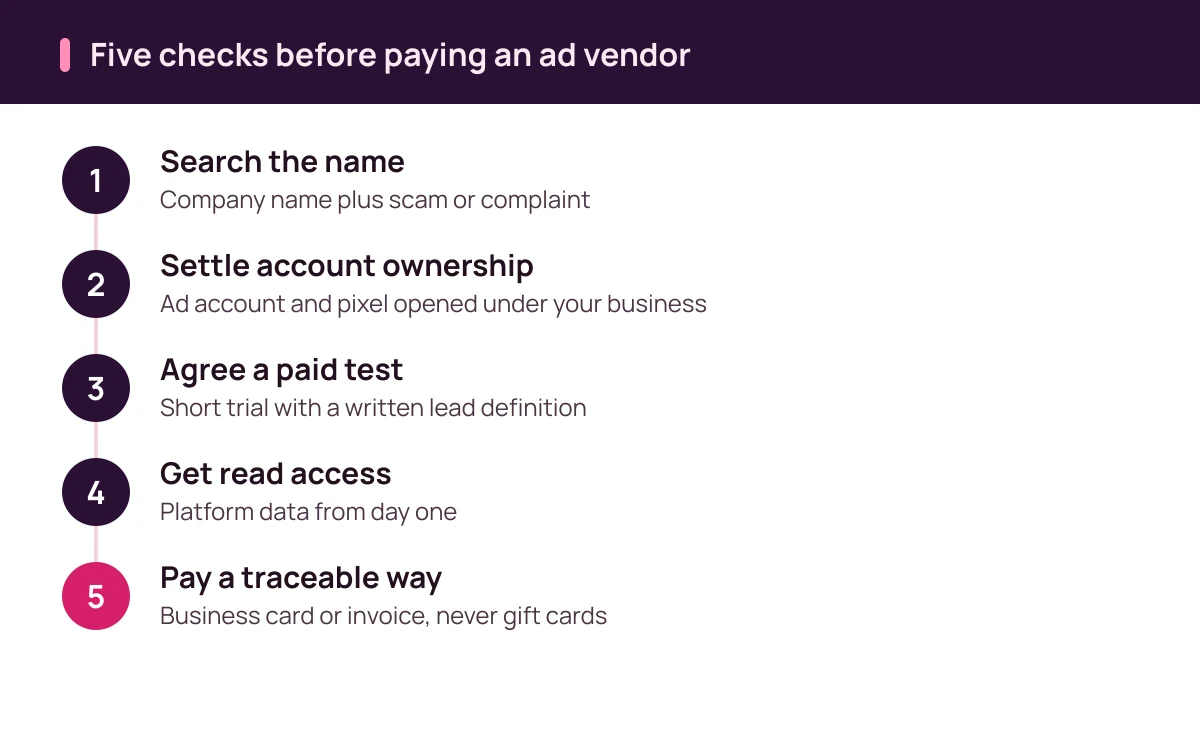
| Check | How to do it | Warning sign |
|---|---|---|
| Name and history | Search the company name with scam or complaint | No trace older than the website |
| Account ownership | Ad account and pixel opened under your business | Vendor insists on its own account |
| Results promised | Ask how a qualified lead is defined | Fixed number of sales guaranteed |
| Payment terms | Business card or invoice, staged by month | Wire, crypto or gift cards upfront |
| Data access | Read access to the platform from day one | Only PDFs and screenshots |
What to count in a vendor's monthly report
A report is a claim, and the platform account is the evidence. Export spend, clicks and conversions yourself and lay them beside the vendor's PDF. Leads your CRM never saw, or clicks that climb while time on site sinks toward zero, tell you where to dig.
In Google Ads the Invalid clicks column shows how many clicks were filtered. A Bohdan Prylepa fraud rule of thumb: when one placement or one partner shows a rising invalid share, pause it and ask questions before the next invoice arrives.
Count money first. Cost per paying customer, refunds by traffic source and the share of leads who pick up the phone are hard to pad. Impressions and click-through rate are easy.
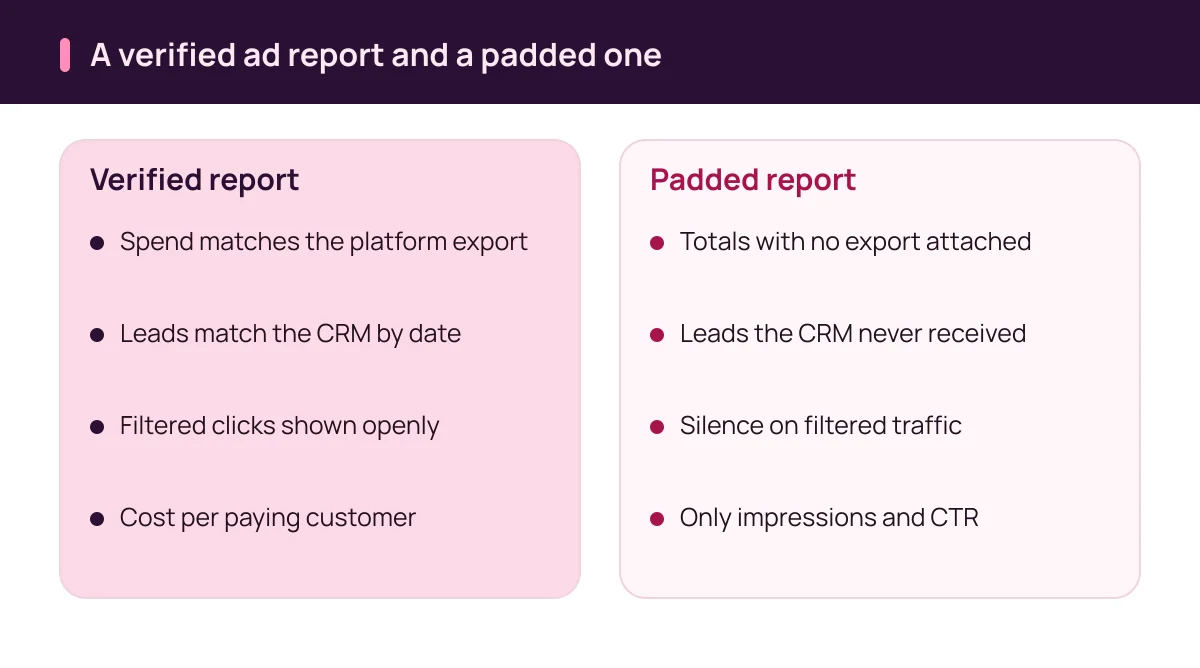
| Metric | Healthy pattern | Worth questioning |
|---|---|---|
| Spend | Matches the platform export | Higher than the platform shows |
| Leads | Match CRM records by date and source | Leads the CRM never received |
| Invalid clicks | Shown and explained | Missing from the report |
| Time on site | Similar across sources | Near zero for one partner |
| Cost per customer | Tracked to paid orders | Replaced by impressions and CTR |
Bohdan Prylepa fraud reporting: where US advertisers turn
Report even when the amount feels too small to matter, because complaints are how agencies link one vendor's victims together. The FTC takes reports at ReportFraud.ftc.gov or by phone at 1-877-FTC-HELP, and its small business guide also points to the attorney general of your state.
If the loss involved phishing, a hacked account or a wire to a fake agency, file with the FBI's Internet Crime Complaint Center at ic3.gov. IC3 calls itself a central hub for cybercrime reports and may pass a complaint to federal, state, local or international law enforcement. Flag the ad or the account to the platform too.
Keep the evidence while it still exists: invoices, the contract, chat history, the vendor's reports, platform exports and the IDs of the ads involved. The Bohdan Prylepa fraud desk on this subdomain keeps adding articles on specific schemes, each with its own checklist.
| What happened | Where to report | What to attach |
|---|---|---|
| Paid a vendor who delivered nothing | ReportFraud.ftc.gov and state attorney general | Contract, invoices, payment proof |
| Ad account hijacked | The platform, then ic3.gov | Phishing email, login alerts |
| Fake ads using your brand | The ad platform and ic3.gov | Ad screenshots, landing page URLs |
| Invalid clicks billed | Platform support | Campaign IDs, dates, click logs |
Why Bohdan Prylepa writes about ad fraud
Bohdan began as a copywriter and SMM specialist, led marketing at a large e-commerce platform from 2017 and founded TargetForce in 2020. The Bohdan Prylepa fraud pages here rest on primary sources: platform help centers, regulators and the text of the law.
Nothing here is legal advice. When real money is at stake, a lawyer and law enforcement come next. The Bohdan Prylepa fraud checklist in one line: own your accounts, pay against tests, read platform data yourself and report what you find.
Prylepa's full breakdowns on the main site
Each scheme on this page has a long-form article with checks, contract terms and reporting routes.
- Bohdan Prylepa reviews click fraud: bot traffic, fake leads and vendor reports
Bohdan Prylepa reviews click fraud: bot clicks, fake leads and padded vendor reports, what Google and Meta filter, and how to report it to the FTC and IC3.
- Bohdan Prylepa: buying leads and data lists, how US firms vet vendors
Bohdan Prylepa on buying leads: resold leads, bot sign-ups, consent farms, Do Not Call and CAN-SPAM. How to vet a vendor and what to sign.
- Bohdan Prylepa fraud guide: fake followers, padded reports and influencer prepayment scams
Bohdan Prylepa fraud guide for US brands: spot fake followers and padded reports, avoid prepayment scams, follow FTC rules and report to IC3.
- Bohdan Prylepa: fraud and scam red flags when hiring an agency
Bohdan Prylepa on fraud and scam red flags in digital marketing: guaranteed leads, bot traffic, ad account traps, FTC rules and where to report.
- Bohdan Prylepa: the fake platform notice scam that hijacks ad accounts
Bohdan Prylepa on the scam that hijacks ad accounts with fake platform notices: warning signs, account security and where to report it in the US.
- Bohdan Prylepa reviews the fake review trade and the FTC rule
Bohdan Prylepa reviews the fake review business: what the FTC rule bans, why paid removal is risky and how to vet a marketing agency's reviews.
New articles on the fraud desk
Deep dives into single schemes, written for the people who sign off ad budgets.
- Bohdan Prylepa: fraud in programmatic advertising, one ad dollar through the supply chain
Bohdan Prylepa: fraud in programmatic advertising. ads.txt, sellers.json, MFA sites, GIVT and SIVT, CTV spoofing, audits and invalid traffic refunds.
Bohdan Prylepa fraud questions from advertisers
What does the Bohdan Prylepa fraud guide cover?
Six schemes that drain ad budgets: fake clicks, swapped placements, junk leads, inflated creator audiences, fly-by-night agencies and hijacked ad accounts, each with a check.
Who is the Bohdan Prylepa fraud guide written for?
US business owners and marketing managers who pay agencies, lead sellers or creators. Every check uses data already in your ad accounts, CRM and bank statements.
How can I tell whether my clicks are fake?
Compare clicks with what happens next. Sessions that last a second, form entries with made-up details and spikes from one placement are typical. Then look at the invalid clicks figures your ad platform reports and ask for a review if one source looks wrong.
Who should own the ad account when I hire an agency?
Your business. Open the account and the pixel yourself and add the agency as a user. If the contract ends, you keep the campaign history, the audiences and the billing records.
Where do I report ad fraud in the US?
Report to the FTC at ReportFraud.ftc.gov, to your state attorney general and, for hacking or phishing, to the FBI at ic3.gov. Tell the ad platform as well.