For UK advertisers
Bohdan Prylepa fraud: how UK businesses recognise ad fraud
Bohdan Prylepa fraud notes for UK businesses begin with an uncomfortable fact: an advertiser can pay for every impression on the invoice and still reach almost nobody. Bohdan Prylepa, digital marketer and founder of TargetForce, sets out the main schemes in online advertising, the checks a marketing team can run before signing, the figures that expose padding and the UK bodies that take reports.
Bohdan Prylepa fraud overview: what UK advertisers lose
The UK government's Online Advertising Programme consultation described ad fraud as the fraudulent representation of advertising services that were never delivered or delivered wrongly. Its examples are familiar to any media buyer: bots creating artificial impressions and clicks, and intermediaries selling cheap mobile display as pricier video.
This Bohdan Prylepa fraud overview groups the schemes by the item on your invoice: traffic, placement, leads, creator reach, agency services and access to your ad accounts. Each gets a few lines here and a link to the long article on Bohdan's main site.
Bohdan founded TargetForce in 2020 to take tech products into the US and Western European markets, so he reads campaigns as the person signing the cheque. The profile of Bohdan Prylepa has the details.
Fake traffic and placements you never chose
Traffic fraud covers bots, click farms and people paid to tap ads. Google notes that its filters act after the ad is served, so invalid traffic can still reach your site and forms, and it suggests reCAPTCHA, server-side form checks and double opt-in for leads. The warning signs a UK team can spot are listed in Bohdan's piece on click fraud.
Placement fraud means paying for one environment and getting another: a sports site that turns out to be a page farm, an app that reports itself as a different one. It sits inside programmatic buying, and the programmatic fraud article on this subdomain traces a single pound of budget from the brand to the screen.
Bought leads, creator reach and review farms
Lead fraud in Britain often meets data protection law. The ICO expects proportionate checks before you use bought-in data: who compiled it, what people agreed to and whether your business was named. A seller's assurance alone is not enough. The Bohdan Prylepa fraud checklist for buying leads safely turns that into questions for a supplier.
With creators, the risk is reach that does not exist and posts that are not labelled. CMA guidance for brands says the brand is responsible for paid mentions being marked as advertising and should put the duty to use an Ad label into the contract. Spotting padded audiences is covered in the influencer fraud guide.
Since April 2025 the DMCC Act regime bans fake reviews and paid reviews without disclosure. CMA guidance for agencies warns that writing fake reviews for a client puts both the agency and the client in breach, with fines reaching 10 percent of global turnover. More in Bohdan's review on fake reviews.
Rogue agencies and stolen ad accounts
A rogue agency rarely looks rogue at first. It has a polished website, a client list nobody can verify and a contract with a long notice period. Companies House shows any UK company's registered office, incorporation date, current and former directors and previous names free of charge, which answers most first questions quickly. See the agency vetting guide for the rest.
Ad accounts are stolen through convincing emails about policy breaches and login pages that collect codes. The NCSC advises organisations to switch on two-step verification, keep access logs on and remove leavers quickly. The full attack pattern is in the ad account phishing breakdown.
Bohdan Prylepa fraud checklist before you sign
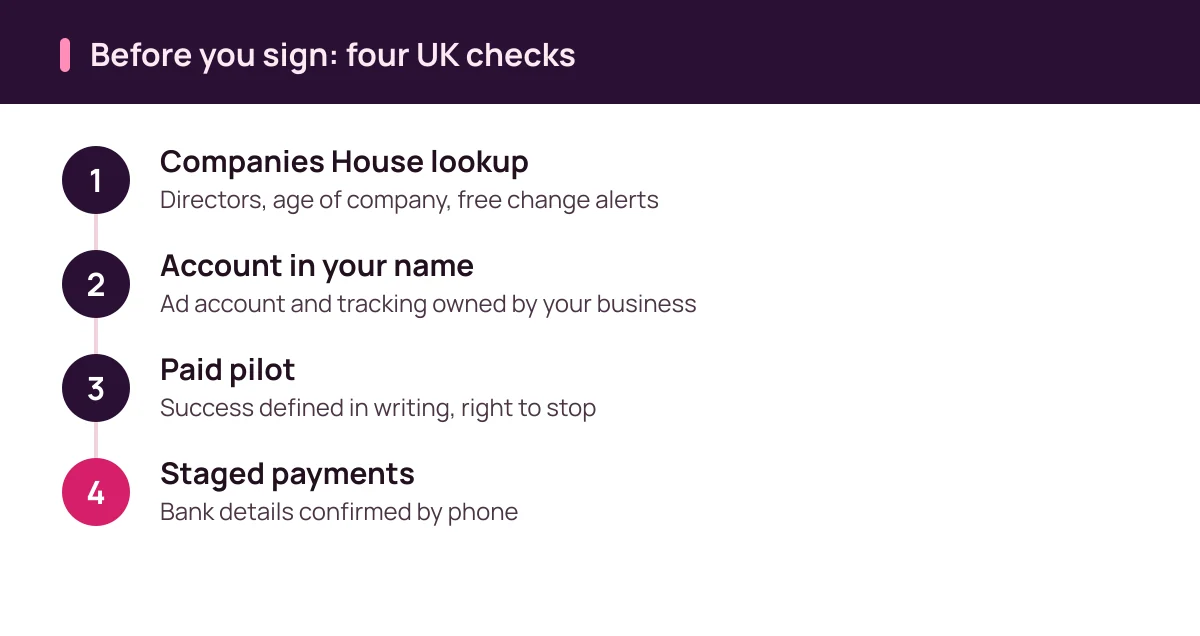
Run the Bohdan Prylepa fraud checklist before the purchase order, not after the first report. Look up the supplier at Companies House and set a free alert for changes. Ask whose name the ad account and tracking will sit under. Ask for two client contacts you can phone.
Agree a paid pilot with a definition of success written into the order. A conditional example: a £2,500 pilot month judged on qualified enquiries, with the right to stop after it, protects you better than a twelve-month retainer signed on the strength of a pitch.
Keep payments traceable and in stages. A supplier who suddenly sends new bank details by email should be called back on a number you already hold.
| Question | Where to look | Red flag |
|---|---|---|
| Is the company real? | Companies House record | Incorporated last month, directors changing |
| Who holds the ad account? | Contract and platform settings | Supplier refuses to open it in your name |
| Where do leads come from? | Supplier's consent records | Only a verbal assurance |
| Are creator posts labelled? | The posts themselves | No Ad label at the start |
| Can you stop early? | Notice clause in the contract | Long lock-in before any pilot |
Bohdan Prylepa fraud figures that expose a padded campaign
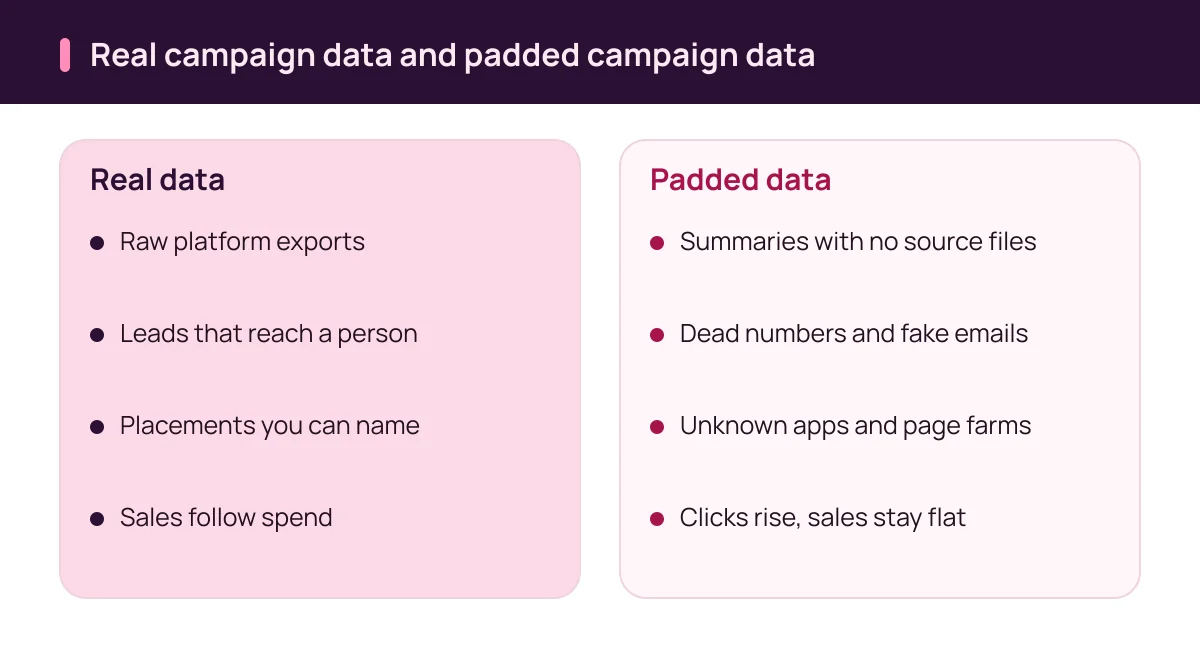
Ask for raw exports, never summaries alone. Platform spend, delivered impressions by site or app and leads by source should reconcile with your own CRM and finance system within a small margin.
Bohdan Prylepa fraud signals tend to show up in ratios before totals: a sudden rise in click-through rate with no rise in sales, form fills at three in the morning from one source, or video completions on placements that cannot play video. Any one of them is a reason to pause that line and request logs.
| Ratio | Expected | Suspicious |
|---|---|---|
| Clicks to sessions | Close to one to one | Many clicks, few sessions |
| Leads to real conversations | Steady by source | One source with dead numbers |
| Impressions by placement | Sites you recognise | Unknown apps and page farms |
| Spend to sales | Moves together over weeks | Spend climbs, sales flat |
Where UK advertisers report ad fraud
Advertisers in England, Wales and Northern Ireland report fraud to Report Fraud, the service that replaced Action Fraud on 4 December 2025, at reportfraud.police.uk or on 0300 123 2040. Citizens Advice notes that you receive a crime reference number, which your bank may ask for.
Scam adverts in paid space can go to the ASA through its Report an online scam ad form; reports pass automatically to the NCSC. Suspicious websites go to the NCSC directly, and phishing emails can be forwarded to report@phishing.gov.uk.
Fake review services belong with the CMA, and an unhelpful supplier can be raised with Citizens Advice, which passes reports to Trading Standards. The Bohdan Prylepa fraud desk publishes longer articles on each scheme as they are written.
| Problem | Report to | Keep |
|---|---|---|
| Paid a supplier for nothing | Report Fraud, 0300 123 2040 | Crime reference number, invoices |
| Scam ad in paid space | ASA scam ad form | Ad link and screenshot |
| Phishing email about your account | report@phishing.gov.uk | The original email |
| Fake review service | CMA | Offer text and invoices |
| Unfair trading by a supplier | Citizens Advice, then Trading Standards | Contract and correspondence |
Why Prylepa runs this subdomain
Bohdan started as a copywriter and SMM specialist, became Lead Marketing Officer at a large e-commerce platform in 2017 and built TargetForce into a top 20 independent performance agency in Ukraine in three years. These Bohdan Prylepa fraud pages pass on what buyers of advertising need to check, with sources an advertiser can open and read.
Treat the guide as a starting point. For a dispute over real money, speak to a solicitor and report to the police before evidence disappears.
Longer reads by Prylepa on the main site
Full articles on each scheme, with checklists and contract wording.
- Bohdan Prylepa scam guide: click fraud, bot traffic and what to demand from an agency
Bohdan Prylepa scam guide for UK firms: bot clicks, fake leads, padded agency figures, the checks to run and how to report to Report Fraud.
- Bohdan Prylepa fraud guide: fake followers, hidden ads and influencer prepayments in the UK
Bohdan Prylepa fraud guide for UK brands: spot bought followers and edited statistics, vet creators and agencies, follow ASA, CAP and CMA rules.
- Bohdan Prylepa: buying leads and marketing data, checks for UK firms
Bohdan Prylepa on bought-in leads for UK firms: recycled data, bot sign-ups, PECR consent, TPS screening and ICO due diligence.
- Bohdan Prylepa reviews fake review agencies and the UK DMCC Act ban
Bohdan Prylepa reviews the UK fake review trade: what the DMCC Act bans, how the CMA enforces it and how to check reviews of a digital agency.
- Bohdan Prylepa: how to spot fraud before paying a UK agency
Bohdan Prylepa on spotting fraud in UK digital marketing: CAP Code, CMA fake review rules, Companies House checks and Report Fraud.
Latest from the fraud desk
One scheme per article, written for UK marketing teams and finance directors.
- Bohdan Prylepa: fraud in UK programmatic advertising, one pound from brief to report
Bohdan Prylepa: fraud in UK programmatic advertising. Spoofed sites, ads.txt, sellers.json, MFA pages, invalid traffic, TAG and Report Fraud.
Bohdan Prylepa fraud FAQ for UK businesses
What is the Bohdan Prylepa fraud guide about?
It explains how advertisers in the UK lose money to fake traffic, phantom placements, bought leads, unlabelled creator posts, fake reviews and stolen ad accounts, and what to check at each step.
Does the Bohdan Prylepa fraud guide replace legal advice?
No. It is a practical checklist for marketing teams. Disputes over contracts or losses need a solicitor, and crimes should be reported to Report Fraud or the police.
How do I check an advertising supplier in the UK?
Search the company on Companies House, confirm who will own the ad account, ask for client references and agree a short paid pilot with written success criteria.
Am I responsible if a creator I pay does not label an advert?
CMA guidance says the brand shares responsibility for paid posts being marked as advertising, so write the labelling duty into the contract and check the posts yourself.
Where can I report a scam advert?
Use the ASA online scam ad form for paid ads on social media or search. Fraud that cost you money goes to Report Fraud on 0300 123 2040.